


Someone Else Said The Quiet Part Out Loud
At AI Engineer Europe (presented by Google DeepMind), Mario Zechner — creator of pi, the core agent framework that powers openclaw — put this on screen during his talk, Building Pi in a World of Slop: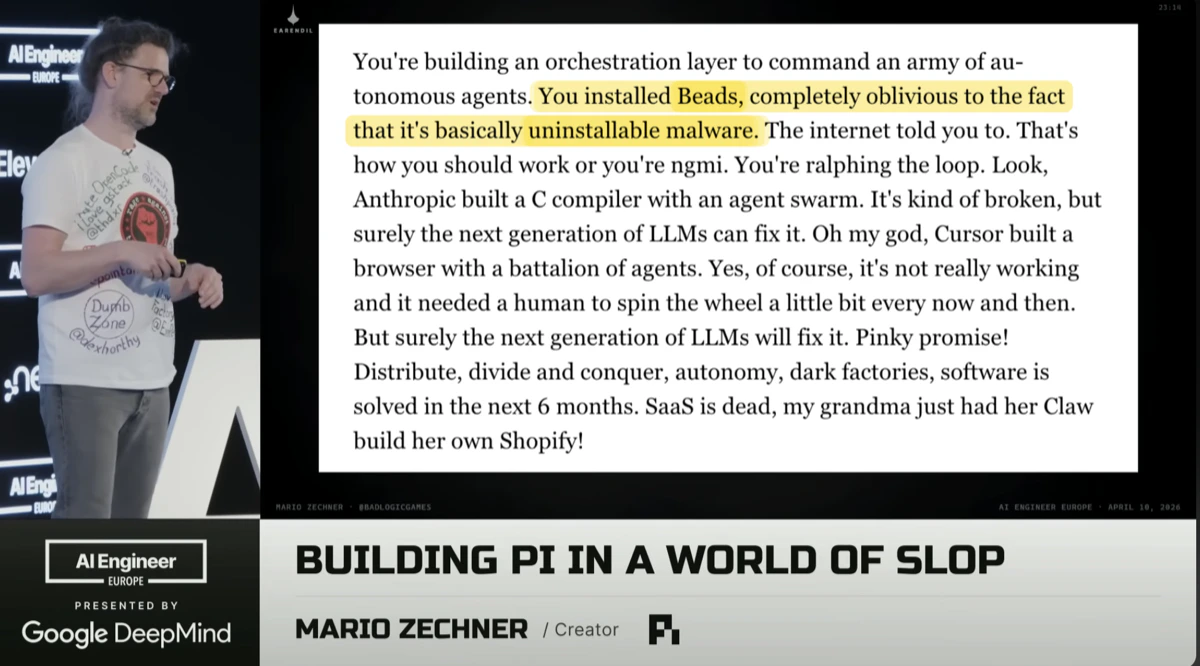
Mario Zechner, AI Engineer Europe: Building Pi in a World of Slop
“You installed Beads, completely oblivious to the fact that it’s basically uninstallable malware.”That’s a spicy framing. But he’s not wrong about the underlying mechanic, and it’s the exact failure mode ticket-rs was built to avoid.
The Daemon Tax
Steve Yegge’s beads introduced a lot of good ideas — structured, terminal-native issue tracking designed for coding agents, dependency-aware triage, graph-native prioritization. I wrote about this already: beads was one of the first projects to ask the right question. Where it gets into trouble is the runtime. beads runs a long-lived SQLite-backed daemon. That daemon:- Persists state outside your repo, in a process you didn’t ask to supervise
- Holds file locks that outlive your terminal session
- Has to be cleanly shut down or you get zombie state
- Adds IPC overhead to every single command your agent runs
triage and ready and next in a tight loop — dozens of tool calls per session — you pay that tax on every single hop. And when the daemon misbehaves, you’re debugging a background process instead of your code.
Mario’s phrasing is harsh, but the point lands: software that installs a persistent background process without making that contract obvious is software that’s hard to reason about, hard to uninstall, and hard to trust inside an autonomous loop.
Why ticket-rs Is Stateless By Design
ticket-rs takes the beads ideas — graph-native backlog, dependency-aware triage, CLI-first UX — and deletes the daemon.- No background process.
tkis a single ~10MB Rust binary. It starts, reads files, exits. - State lives in your repo. Issues are markdown files with YAML frontmatter in
.tickets/.git logis your audit trail. - The graph is incremental. Analytics results (PageRank, betweenness, critical path) are cached to
.tickets/.cache/and invalidated per-file by SHA-256 hash. Change one ticket, recompute the delta, not the world. - Every invocation is fresh. No zombie locks, no “is the daemon running,” no supervision burden for you or your agent.
tk triage completes in 14–21ms on a 500-ticket repo. A daemon-backed system pays an IPC round-trip before it even starts work. Zero daemons turns out to be faster, not just cleaner.
Agents Don’t Want Daemons Either
This is the deeper point, and it’s what Mario is really getting at with pi. A coding agent is a stateless function call. Context in, next step out. Everything in its world should be composable, inspectable, and cheap to call. The moment you introduce a long-running process into that loop, you’ve added:- A supervision contract the agent can’t fulfill. It can’t
systemctl statusyour daemon from inside a sandbox. - A hidden failure mode. When the daemon is wedged, every tool call looks like a tool bug.
- A trust problem. “What else is this thing doing on my machine?”
The Thesis, Restated
- Daemons are a liability when your primary user is an autonomous loop.
- The state you want is in your git repo, not in a SQLite file a sidecar process owns.
- The graph you want is derived from that state, incrementally, every call.
- Fast, stateless, inspectable tools compose. Long-running services don’t.
Install ticket-rs
60 seconds. One binary. No daemon.
Watch the talk
Mario Zechner — Building Pi in a World of Slop